A necklace does not arrive on an empty background when you wear a collared shirt. The points, opening and fastening already draw lines near the face. Before buying another accessory, imagine three versions of one plain shirt with the same trousers and the same hair arrangement. Only the shirt opening and the necklace change. These are original outfit proposals, not photographs of a fitting or a system for assigning jewelry to face shapes.
First arrangement: an open collar with no necklace
Imagine the collar open enough to leave a visible V-shaped area. With no necklace, its two sides remain the main lines in that part of the outfit. My interest is the empty area they enclose and the way the collar points turn away from it. Empty does not mean unfinished; it can be the visible relationship you choose to keep.
Getty's art vocabulary treats lines as defining edges and directions in a composition. That provides a way to describe the collar without claiming that an open V produces the same effect on every wearer. The actual shirt's cut and how it sits still matter. This proposal supplies no universal number of buttons to leave undone.
Second arrangement: repeat the opening with a necklace
Keep the same imagined opening and add a necklace whose visible line sits inside it. Now there are two related outlines: the shirt's edge and the accessory. I would look at the space between them before considering a pendant or another decorative element. A close repetition could make the necklace feel connected to the shirt; it could also create a crowded pair of lines I do not enjoy.
That is a question for the actual pieces together, not a reason to buy a necklace based on a generic length label. A product photograph on another shirt cannot establish where it will fall in yours. Nothing in this imagined comparison proves the clasp's comfort, a metal's suitability or how the piece will behave as you move.
Third arrangement: close the collar and leave it alone
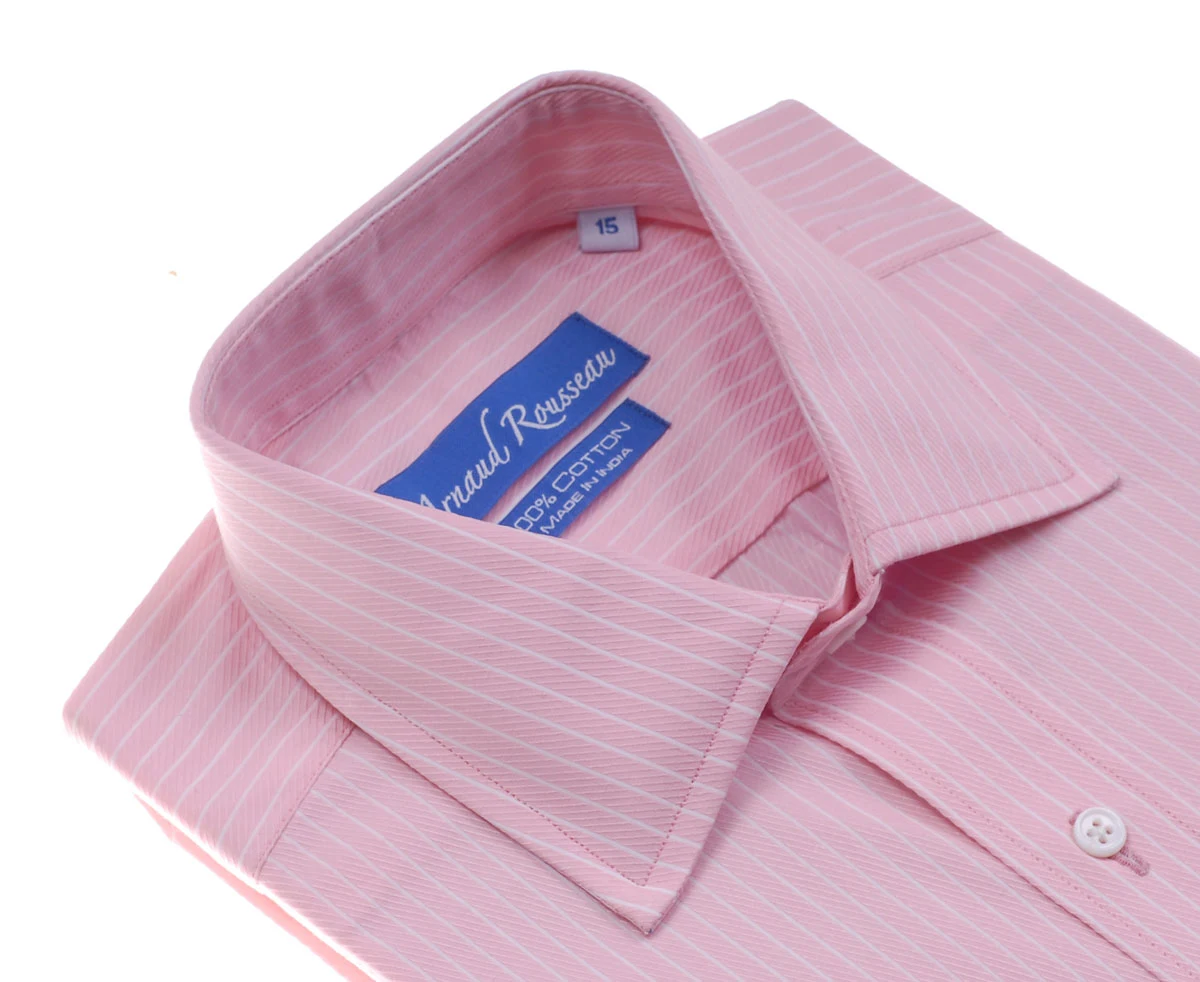
In the third proposal, the shirt fastens higher and no necklace is added. The opening no longer creates the same exposed V. The collar itself becomes a more complete shape, and the front fastening continues its own line below. This is a different arrangement from the first, even though both omit jewelry.
I would choose this version when the shirt's particular collar is the part I want to see clearly. It is not a claim that a closed collar is inherently formal or that an unadorned outfit suits every occasion. Nor does it require replacing the missing necklace with earrings. The active decision concerns the shirt's line, rather than finding another accessory to perform the same job.
Let the shirt answer before the shopping basket
Compare what changes between the three proposals: an open area on its own, an opening with an additional line, and a more closed collar without that addition. The choice is not simply jewelry versus no jewelry. It is whether the accessory helps develop the particular neckline relationship you want.
Use the shirt you own as the starting point if you consider a purchase. Seeing the real combination may confirm that a necklace adds something useful, or that the collar already supplies enough interest. This feature recommends no particular product and reports no try-on. A good visual reason to keep the shirt unadorned is a complete decision, rather than a shopping task left unfinished.
Sources & further reading
Published sources for the details and examples discussed in this story.