Flowers can organize a textile without telling us how the textile was made. A repeated leaf is a subject; discharge printing and embroidery describe different work on a ground. Two Cleveland Museum of Art records make that distinction concrete: a Strawberry Thief printed cotton and a Moroccan embroidery sampler. Read their materials, techniques and visible layouts together, rather than treating a botanical resemblance as a manufacturing description.
Start with two identified objects
The museum identifies Strawberry Thief, accession1937.696, as plain-weave cotton, discharge printed, dated about1936. William Morris is named as designer, with the life dates1834–1896. Those fields belong together: the design attribution does not mean Morris physically produced this particular cloth in1936. Keep the object’s date separate from the designer’s lifetime.
The second object is Embroidery sampler (chelliga/shelliga), accession1929.831, attributed to a Moroccan embroiderer and dated to the1700s. Its medium is listed as cotton, silk and dye. The description specifies dyed silk thread used for double-running, straight and long-armed cross stitches. Those stitch names come from the museum’s account, not from identifying every small mark in the online front image.
Read the print as a documented color process
For Strawberry Thief, the museum describes cloth dyed blue before bleaching and block printing. The important contrast is not simply “color added to cloth.” Discharge involves a change to an already colored ground. Keeping that sequence visible avoids treating every pale area as if it must have been created by laying white thread across the fabric.
In the supplied whole image, paired birds sit among interlacing foliage and flowers on a dark blue field. Repetition carries the design across the rectangular piece. This broad arrangement is visible, while the record supplies the manufacturing description. Neither the pattern’s regularity nor its botanical subject, by itself, proves the technique.
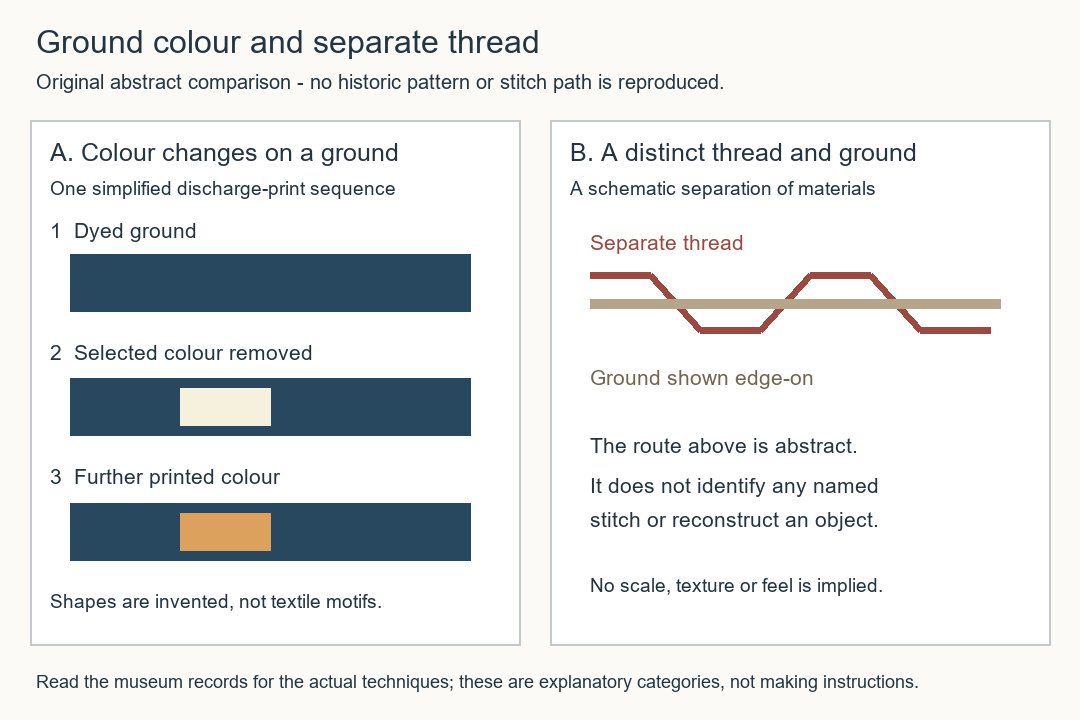
The original diagram below reduces the color sequence to invented rectangular patches. Its purpose is to distinguish a changed ground color from a separate thread. It does not reproduce the birds or flowers, specify dyes or bleaching agents, or reconstruct the complete historical production process. Other printed textiles need their own technique records; this particular description is not a definition of every print.
Read the sampler as work with separate thread
The sampler’s whole front image presents a different organization: vertical fields hold groups of geometric and botanical forms, with narrower patterned bands and larger shapes sharing the surface. The changes of direction and density invite comparison within the piece. A reader can follow one field and then another without pretending to recognize every named stitch from the reproduction.
Here the museum’s explanation identifies silk thread and particular stitches. In the diagram, an invented line passes above and below an edge-on ground to make the distinction between thread and foundation legible. That abstract route is not a drawing of double-running, straight or long-armed cross stitch, and it is not the sampler’s unseen reverse.
Do not expand the material list into a weave specification that the record has not supplied. Cotton, silk and dye are not equivalent to the printed textile’s explicit plain-weave cotton description. Nor does the front image establish a raised feel, softness, the amount of work involved or how a modern garment made by a related technique should be washed.
Finish with two different explanations of the motif
A useful completed reading for the print is: “The visible birds and foliage repeat across a cotton textile whose record documents discharge printing; the accompanying description begins with a blue-dyed ground.” For the sampler: “The varied botanical and geometric fields belong to an embroidered object whose description identifies dyed silk thread and several stitch types.” These are two explanations of construction, not competing claims about which floral surface is better.
The distinction can travel into a product enquiry without turning either museum object into a shopping recommendation. If a contemporary listing says only “floral,” the subject remains clear while the technique remains open. Ask whether the motif is printed, embroidered or made another way, and retain the seller’s actual composition and care information for that item. A photograph resembling these textiles does not inherit their documented construction.
This comparison uses the museum’s current online records and whole front reproductions, not a visit or physical handling. The useful result is a more precise sentence about each object: what forms organize its surface, what the record says made them, and where the available evidence stops.
Sources & further reading
Published sources for the details and examples discussed in this story.