
Free delivery removes a delivery charge; it does not necessarily reduce the checkout total. To see the difference, give the offer and the basket explicit numbers. In this original example, delivery costs $8 below a qualifying goods subtotal of $85 and is free at $85 or more. All goods count toward the threshold, there are no discounts or other fees, and tax is excluded. These are invented terms, not a current merchant offer.
Basket A: keep the wanted goods and pay delivery
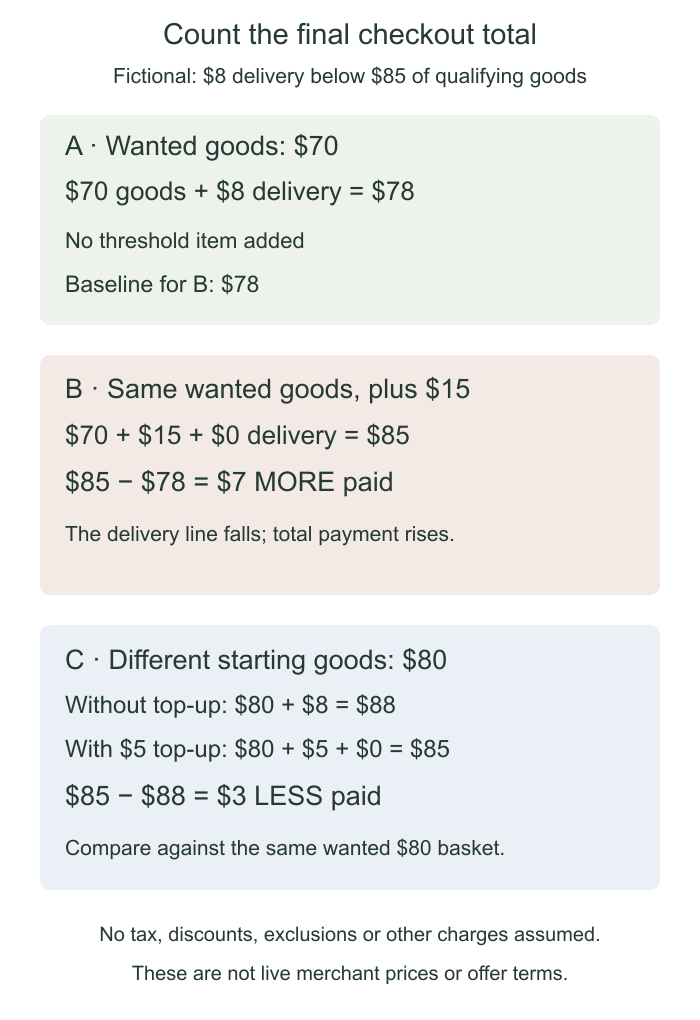
The first basket contains $70 of goods the shopper already wants. It falls below the $85 threshold, so its total is $78: $70 plus $8 delivery. Write both lines down. The goods cost and the delivery cost explain the amount that leaves the account.
This $78 is the baseline for the first comparison. It does not establish whether the goods are good value or whether the shopper should place the order. It simply gives the actual hypothetical checkout amount against which an addition can be measured.
Basket B: add fifteen dollars to remove eight
A $15 extra item brings the goods subtotal to $85, qualifying for free delivery. The checkout total becomes $85. The delivery line has fallen from $8 to zero, but the total has risen from $78 to $85—a $7 increase. Calling that an $8 saving leaves out the $15 spent to obtain it.
If the extra item was not wanted, the shopper now pays $7 more and receives an unplanned object. If it was genuinely part of a purchase already intended, its usefulness is a separate consideration; the cash comparison still shows $85 paid rather than $78. Give that distinction an honest name instead of treating every threshold item as either automatically wasteful or automatically a bargain.
Basket C: start nearer the threshold
Now change the starting goods to $80 because the shopper wants another $10 item. Without a top-up, delivery would make that order $88. A further $5 qualifying item reaches the $85 threshold, removes the $8 delivery charge and produces an $85 total. For this changed basket, the top-up reduces the amount paid by $3.
The result differs from Basket B because the gap is now $5 rather than $15. The delivery charge has not changed. It is therefore important to compare the addition with the correct baseline: $85 against the $88 total of the already wanted $80 basket, not against Basket A’s $78 order with fewer wanted goods.
A useful general expression for this simplified offer is “cost of the addition minus delivery removed.” Fifteen minus eight produces a $7 increase; five minus eight produces a $3 decrease. A qualifying addition costing exactly $8 would break even on checkout cash under these assumptions. None of those calculations establishes whether the added object is useful.
Use the actual terms before applying the comparison
A real offer can define its qualifying subtotal differently. Some goods may be excluded, a discount may change the subtotal or the destination may carry another charge. Read the actual checkout and offer terms before assigning the example’s numbers to a live basket. An attractive banner is not the completed calculation.
Keep three lines visible: the goods originally wanted, the proposed addition and the final delivery charge. Compare the final totals for the same wanted goods. That makes it possible to notice a genuine reduction, a higher payment disguised by a zero delivery line, or a purchase that can simply wait without adding anything today.